Competition in Tall Buildings Prophecy: How It Strengthened an Englishman’s Faith
Competition in Tall Buildings Prophecy is one of the most widely discussed predictions in Islamic tradition. Mentioned in the famous Hadith of Gabriel, the prophecy describes how poor desert shepherds would one day compete in constructing the tallest buildings. For one young Englishman searching for truth, this remarkable prediction became a powerful sign that reshaped his understanding of faith and strengthened his belief in the divine message of Islam.
Divine Prophecy: How the “Competition in Tall Buildings” Strengthened an Englishman’s Faith
Introduction: Searching for Clear Evidence of Truth
During his personal search for truth, a young Englishman was not satisfied with emotional arguments or abstract spirituality. Instead, he wanted tangible evidence that could demonstrate that Islam was not simply another human ideology, but a divine revelation containing knowledge beyond human capability.
His turning point came when he encountered the famous Hadith of Gabriel. In this narration, the Prophet Muhammad ﷺ was asked about the signs of the Day of Judgment.
Among the signs mentioned was a remarkable prophecy: that barefoot, poor shepherds would compete in building tall structures. For the young man, this statement became a powerful piece of evidence that deeply reshaped his understanding of faith.
The Historical and Social Precision of the Prophecy
What impressed the young Englishman most about this prophecy was not only the prediction itself, but the precise description of the people who would fulfill it.
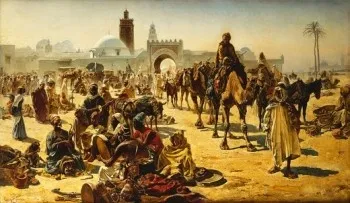
The Prophet Muhammad ﷺ did not vaguely state that buildings would become tall in the future. Instead, he specifically described the builders as “barefoot, naked, destitute shepherds.” Historically, this description closely reflects the Bedouin tribes of the Arabian Peninsula, who lived a nomadic life centered around camel and livestock herding.
For someone analyzing this narration centuries later, the prediction appears striking. It connects a society once defined by poverty and desert nomadism with a future characterized by enormous wealth, modern cities, and advanced engineering capable of constructing skyscrapers.
From Desert Shepherds to Skyscrapers
The young man became particularly intrigued by the Arabic word “yatatawalun,” which means competing in height. This phrase suggests not just building tall structures, but actively striving to surpass one another in height and architectural ambition.
When he compared this description with the modern world, he noticed a remarkable parallel in the Arabian Peninsula. Cities such as Dubai, Riyadh, and Jeddah have become global centers for ambitious skyscraper projects and architectural competition.
Modern landmarks seemed to reflect this transformation. The Burj Khalifa stands as the tallest structure in the world, while projects like the Jeddah Tower aim to break new global records.
For the young Englishman, these developments appeared to mirror the prophetic description spoken more than 1,400 years ago in a desert society with no tradition of skyscraper architecture.
Comparing Divine Prophecy and Human Predictions
As part of his investigation, the young man compared this prophecy with well-known historical predictions made by figures such as Nostradamus.
Human predictions are often characterized by vague wording, symbolic language, and multiple possible interpretations. In many cases, people interpret them only after historical events occur, adapting the predictions to fit the outcome.
By contrast, the prophecy about competing in tall buildings appears unusually clear. It identifies the people involved, the action they would perform, and the manner in which it would occur. This level of clarity led the young man to believe that the Prophet Muhammad ﷺ was not making a speculative prediction but describing knowledge revealed by the Creator of time.
A Turning Point in His Faith Journey
The prophecy of competing in tall buildings became a turning point in the young man’s intellectual journey. If the Prophet Muhammad ﷺ could accurately describe such a transformation in society centuries in advance, the young man reasoned that other teachings about unseen realities might also be true.
These include core Islamic beliefs about the afterlife, Paradise, Hell, and resurrection.
He concluded that the connection between poor desert shepherds and the construction of the tallest towers in the world seemed too precise to dismiss as coincidence. Instead, it appeared to point toward a deeper source of knowledge beyond human speculation.
Conclusion: From Doubt to Certainty
In the end, the young Englishman described the prophecy of competing in tall buildings as the intellectual sign that spoke directly to his logical and analytical mindset. While he had initially searched for answers about the future through science and philosophy, he felt he had discovered a description of the modern world within the words of the Prophet Muhammad ﷺ.
This realization ultimately led him to embrace Islam and declare the Shahada, transforming a journey of doubt into a conviction of faith.