The Journey of Dr. Gerald Dirks: From the Pulpit to the Path of Fitra
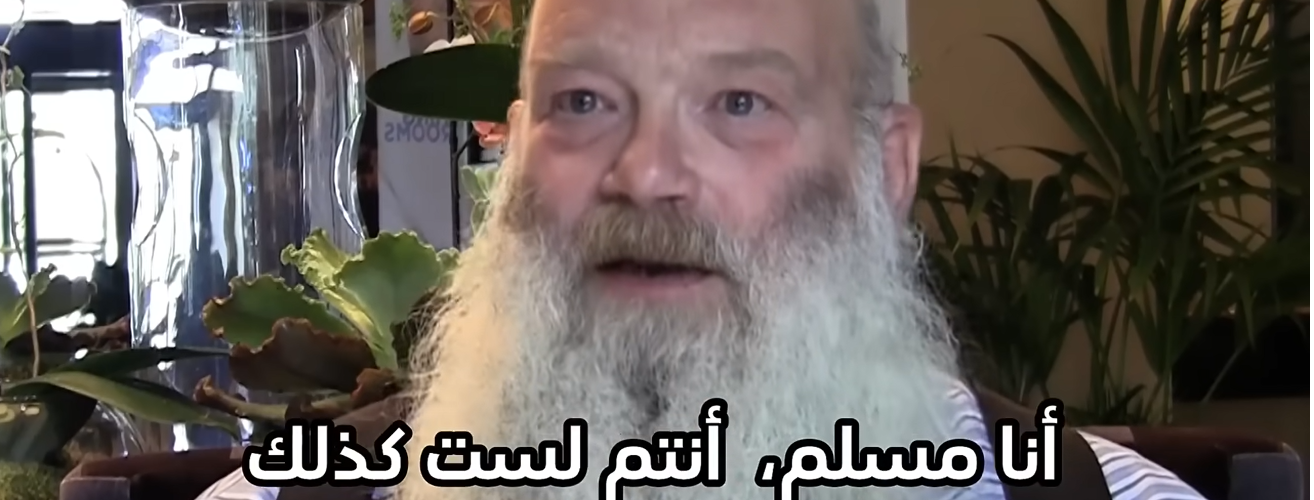
The Journey of Dr. Gerald Dirks: From the Pulpit to the Path of Fitra
A Rational and Psychological Analysis of a Transformation
The story of Dr. Gerald Dirks is not a typical conversion story; it is a profound “intellectual deconstruction” by a man who held a Master of Divinity from Harvard University and was an ordained minister in the United Methodist Church.
I. The Seeds of Doubt (The Intellectual Conflict at Harvard)
The journey began long before he met a single Muslim. At Harvard, Dirks studied the Bible not as a devotional text, but through Historical-Critical Analysis.
-
The Conflict: He discovered a massive gap between the “Historical Jesus” and the “Christ of Dogma.” His research into ancient Greek manuscripts revealed that concepts like the Trinity and the Divine Sonship were late theological developments, not original teachings of Jesus.
-
The Rational Conclusion: Even as a minister, Dirks became a “Unitarian” in belief. He believed in One God and saw Jesus as a Great Prophet, but he felt trapped within a church structure that demanded he preach doctrines he knew were historically fabricated.
II. The Catalyst: The Power of Silent Dawah
The psychological shift occurred when Dirks, a lover of Arabian horses, met a Muslim man named Jamal.
-
Observation vs. Preaching: Jamal never gave Dirks a book or a lecture. Instead, Dirks observed Jamal’s character. When it was time for prayer, Jamal would quietly perform ablution (Wudu) and pray in a corner of the stable.
-
The Psychological Impact: This “living Islam” deeply moved Dirks. He saw a direct, unmediated connection between man and Creator—no priests, no altars, no complex rituals. He began to wonder: “What is the source of this inner peace and discipline?”
III. The Cognitive Reconciliation (Reading the Quran)
Dirks returned to his library, picking up translations of the Quran (specifically by Yusuf Ali). This was the stage of Rational Persuasion:
-
The “Aha!” Moment: As he read, he felt the Quran was speaking directly to his Harvard-trained mind. Every theological “knot” he couldn’t untie in Christianity was resolved in the Quran.
-
The Core Realization: He found that the Quranic Jesus (the Prophet who brought Tauhid/Monotheism) was exactly the “Historical Jesus” he had been searching for in his academic research. He realized he didn’t have to “change” his beliefs; he simply had to “recognize” that his true beliefs were already titled “Islam.”
IV. The Psychological Struggle (The Identity Crisis)
Despite his intellectual conviction, Dirks faced an intense internal struggle that lasted for months:
-
The “Non-Typical Christian” Label: For a long time, he refused to call himself a Muslim. He called himself a “Non-Typical Christian” who happened to believe in the Quran, fast Ramadan, and pray the five daily prayers in English.
-
The Fear of Social Exile: As a prominent PhD in Psychology and a former minister, the social cost of conversion was immense. He was afraid of losing his identity, his community, and his status in the West.
V. The Moment of Truth (The Desert Encounter)
The climax of his struggle occurred in a Palestinian refugee camp in Jordan. An elderly man, who spoke no English, looked Dirks in the eye and asked a simple question in Arabic:
“Anta Muslim?” (Are you a Muslim?)
-
The Breaking Point: Dirks couldn’t give his usual 20-minute academic explanation in English. He realized that the time for “theological hedging” was over.
-
The Final Surrender: He looked at the man and simply said, “Na’am” (Yes).
-
The Result: At that moment, the psychological weight of the “Non-Typical Christian” mask fell away. He described a feeling of immense relief—he had finally come home to the Fitra (the natural state of man).
VI. Philosophical Legacy: Islam as the Fulfillment
In his book The Cross and the Crescent, Dirks outlines his final rational framework:
-
Continuity, Not Contradiction: He argues that becoming Muslim did not mean betraying Jesus; it meant finally following Jesus correctly.
-
The Superiority of Tauhid: He asserts that the Islamic concept of God is the only one that satisfies both the human heart and the logical mind.
-
The Bridge: He now spends his life acting as a bridge, explaining to Christians that Islam is not a “foreign” religion, but the “Restoration” of the original message given to all prophets from Abraham to Jesus.
Key References for the Reader:
-
Dirks, G. F. (2001). The Cross and the Crescent. Amana Publications.
-
Dirks, G. F. (2002). Abraham: The Friend of God. Amana Publications.
-
Public Lecture: “How I Came to Islam,” available on various academic and Islamic platforms.