Lessons of Faith and Action from Lady Hagar
1. The Beginning and the Blessed Gift
Lady Hagar (Hajar) was originally from the land of Egypt. When Prophet Abraham (Ibrahim), peace be upon him, passed through Egypt alongside his first wife, Lady Sarah, a well-known incident occurred with the king of Egypt at that time. God honored Lady Sarah and saved her, whereupon the king gifted Lady Hagar to her to be her maiden.
When Lady Sarah saw that she had not borne children for Abraham, who was advanced in age, she gifted Hagar to him in marriage so that God might bless him with a child. He married her, and she gave birth to Ishmael (Isma’il), peace be upon him. Subsequently, the natural human jealousy arose in Sarah’s heart, and Almighty God commanded Abraham to take Hagar and her nursing infant to another location.
2. The Journey to an Uncultivated Valley
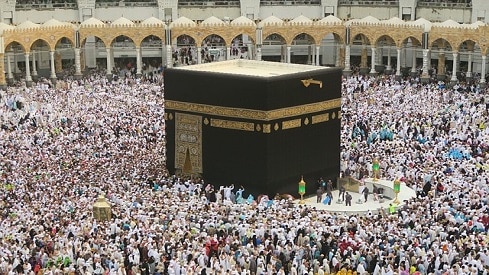
Abraham, peace be upon him, traveled with Hagar and her infant son, Ishmael, until he placed her in Mecca. At that time, Mecca was not as it is today; rather, it was a barren valley, with no trees, no water, and no human companion. He left them at the site of the Kaaba today (which was merely a raised mound or hill of earth).
Abraham left with them a leather bag containing dates and a water skin containing water, then he turned back and set off to return to the Levant (Ash-Sham).
3. The Eternal Words of Certainty (Yaqeen)
Lady Hagar followed her husband Abraham, astonished by being left in this wasteland, and said to him:
“O Abraham! Where are you going and leaving us in this valley where there is no person whose company we may enjoy, nor anything else?”
She repeated the question to him several times, but he did not turn to look at her due to how deeply affected he was as a father and husband, and because he was executing a Divine command. Here, the wisdom and deep faith of Lady Hagar manifested; she understood that this was not merely a human action, so she asked him:
“Has Allah commanded you to do this?”
He replied: “Yes.”
She then spoke with the tongue of absolute certainty that history has immortalized: “Then He will not neglect us.”
She then returned to her child, while Abraham, peace be upon him, proceeded until he faced the Site of the House, raised his hands, and supplicated with his devout prayer mentioned in the Qur’an:
“O our Lord! I have made some of my offspring to dwell in a valley without cultivation, by Thy Sacred House; in order, O our Lord, that they may establish regular Prayer: so fill the hearts of some among men with love towards them, and feed them with Fruits: so that they may give thanks.” (Surah Ibrahim, 14:37 — Translation by Yusuf Ali)
4. The Trial of Thirst and the Sa’i Between Safa and Marwa
The water in the water skin was depleted, and the dates ran out. Lady Hagar became hungry, her milk dried up, and the infant child (Ishmael) began to cry and writhe from the severity of thirst and hunger.
Hagar did not stand idly by in surrender; rather, her maternal instinct and the duty to pursue every available means drove her to action:
-
She looked around and saw Mount Safa as the nearest mountain to her. She climbed it and faced the valley, looking to see if she could spot anyone, but she saw no one.
-
She descended from Safa, and when she reached the valley bed (the low-lying ground), she tucked up her garment and ran hard (which is called Harwalah) until she crossed the valley bed.
-
She then climbed Mount Marwa to see if she could spot anyone, but she saw no one.
-
She repeated this pacing between the two hills seven times. This is the Shari’ah origin of the ritual of Sa’i in Hajj and Umrah today, regarding which the Prophet ﷺ said: “This is the source of the tradition of the walking of people between them.”
5. The Miracle and the Gushing of Zamzam
When she completed the seventh round and was at Marwa, she heard a sound. She said to herself: “Hush!” (silencing herself to listen), and she heard the sound again. She then said out loud: “You have made me hear your voice; have you got something to help me?”
Behold, she saw the Angel (Gabriel/Jibreel), peace be upon him, at the site of Zamzam. He dug the earth with his heel (or with his wing) until water appeared and gushed forth.
Lady Hagar rushed over and started pooling the water with her hands, scooping it into her water skin while it was bubbling up. At this, Prophet Muhammad ﷺ said, expressing gratitude for her action:
“May Allah bestow Mercy on Ishmael’s mother! Had she left Zamzam (flowing) — or had she not scooped of the water — Zamzam would have been a stream flowing on the surface of the earth.”
The free, believing woman drank and nursed her child. The Angel then said to her: “Do not be afraid of being neglected, for this is the House of Allah which will be built by this boy and his father, and Allah never neglects His people.”
6. The Urbanization of Mecca and the Genesis of Civilization
Days passed, and an Arab tribe from Yemen named (Jurhum) arrived near Mecca. They noticed a bird hovering in the sky, and they knew that birds do not hover except over water. They sent two messengers, who found the mother of Ishmael sitting by the water.
The tribe came and asked her permission to settle there and share the water with her. She granted them permission on one condition: “You have no right to possess the water (ownership remains hers).” They agreed to this. Ishmael, peace be upon him, grew up among this Arab tribe, learned the pure Arabic language from them, and married into them. From their lineage arose the Arabized Arabs (Al-Arab al-Musta’ribah) from whom Adnan descended, tracing all the way to Prophet Muhammad ﷺ.
The Goal-Oriented Conclusion (The Purpose):
The story of Lady Hagar in authentic Islamic sources teaches us that reliance on God (Tawakkul) does not mean idleness; rather, it is a profound combination of “absolute certainty within the heart” (Then He will not neglect us) and “exerting the utmost physical effort” (pacing seven times between Safa and Marwa). Consequently, her solitary, faithful striving was immortalized for thousands of years as a collective ritual, walked and run by millions of men and women in pure devotion to God.